
| Year | 2019 |
| Category | Performance |
| Work | INFERNO. Canto III, IV, V |
| Premiere | Vic. Teatre Atlàntida underground car park |
ARTISTIC DATA SHEET
Author Dante Alighieri
Rhapsode Albert Vidal
Dante’s spirit Noe Vidal
Pre-recorded percussion Pitu Andreu
Costumes Oghi Ochir
Sound space Denys Sanz
REVIEW
UNDERGROUND , THE ESSENCE OF THEATRE
The audience entered via the vehicle access ramp, descending first to the first basement level and then to the second level of L’Atlàntida’s underground car park. The parallel was both inevitable and intentional: a descent into Hell.
On Friday, Albert Vidal once again invited spectators into a theatrical experience that began with the staging itself. Theatre is always a convention, but the actor and performer has long been known for pushing those conventions further—just as he did more than four decades ago, when he astonished the people of Vic by performing from the display window of Can Merinos.
Taking theatre out of its conventional spaces is nothing new, but the game Vidal proposes with Inferno goes much further. “Follow me in breaking the boundaries of space. Follow me, too, through a text you will never fully understand, even if you know its context, because I will recite it in the medieval Italian of the fourteenth century in which Dante wrote the Divine Comedy. And follow me as actor and demiurge, because there will be nothing else: me and my gesture, me and my voice, on a stage that could not be barer, in the non-place of an underground car park.”
Word, voice, breath, gesture, silence… what more could theatre possibly need?
The proposal was accepted by the 130 spectators who had prepared themselves not only intellectually but also physically to spend an hour and a half in a bleak, unheated space. They were welcomed by Noé Vidal, the actor’s son, who introduced his father’s arrival in a red minivan descending the ramp. Albert Vidal then took his place on a red Turkish carpet, from which he would barely move for the next ninety minutes. As he himself described it, it was ninety minutes of “theatre without crutches”: word, voice, breath, silence, gesture… what more could theatre require?
Albert Vidal guided the audience through Cantos III, IV and V of Dante’s great poem, one of the masterpieces of world literature.
The audience did have one aid: a brief summary to read before each section, helping them follow the journey through Hell before letting go of the need to understand every word, and instead embracing the essence of what Vidal offered—the descent into darkness guided by the poet Virgil, the crossing with the ferryman Charon, and the encounter with illustrious souls in Limbo and others condemned to eternal torment.
“Lasciate ogni speranza, voi ch’entrate” (“Abandon all hope, ye who enter here”), Dante warns in his poem. The audience descended into the underground car park with one hope: to feel the very heartbeat of theatre in its purest form. Once again, Albert Vidal worked his magic.
Jordi Vilarrodà
EL 9 NOU, 18-11-2019
ALBERT VIDAL DESCENDS FEARLESSLY INTO DANTE’S INFERNO
The chosen location, as unusual as the artist himself, was the -2 level of the underground car park at the Atlàntida Theatre in Vic. The staging was simple, effective, profound, precise, and enhanced by dim lighting that truly transported us to the depths of Hell—to Dante Alighieri’s Inferno from The Divine Comedy.
Vidal chose the first three cantos of the Inferno and recited them like the finest Tuscan rhapsodes of Dante’s own time.
It was a different kind of performance, in which the actor and rhapsode, speaking in fourteenth-century Tuscan, moved and struck the spirit through the 400 chained hendecasyllabic verses arranged in tercets. These verses represent the protagonist’s odyssey towards the heart of darkness and the underworld, accompanied by the poet Virgil.
During the performance, audiences could hear music from the album of telluric chants El despertar de la serp (The Awakening of the Serpent), with keyboard accompaniment by Xavier Jaumot, as well as telluric chants created and directed by Albert Vidal with inmates from the high-security prison of Baganuur in the Mongolian Steppe.
Once again, Vidal proved that he remains in exceptional form and captivated an audience that was receptive and fully committed. A creative work, as always, thirty years ahead of its time.
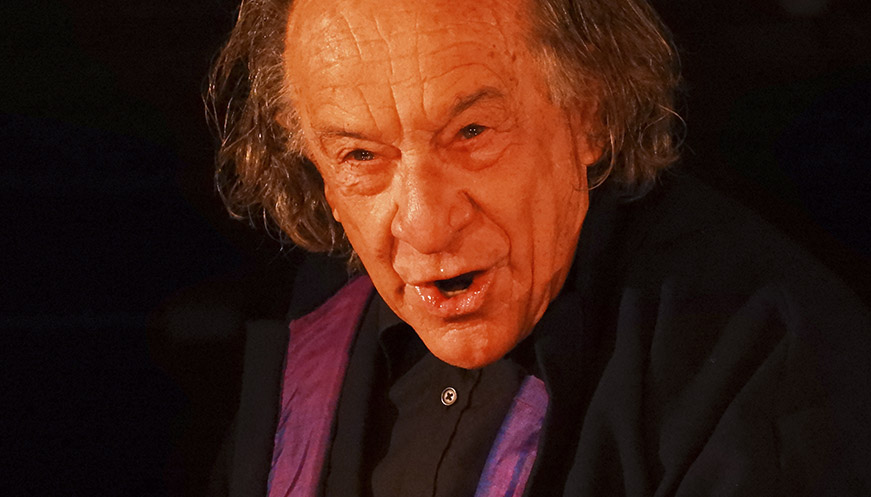
An anthropological and multifaceted artist: storyteller, shape-shifter, actor, set designer, photographer, musician, comedian, dancer, Eastern guru, telluric prince, provocateur, free spirit, lover of silent cinema, an extraordinary mime, excessively expressive, innocent, ironic, with no interest whatsoever in self-image or self-esteem, at times eccentric, naïve, onomatopoeic, always on the edge and close to the abyss, anti-technical, innocent, satyr, nomad, temporary settler, fabulist, therapeutic, spiritual, metamorphic, follower of Japanese Butoh dance, seeker of unimaginable horizons, jester, critic, reflective thinker, virtuoso, improviser, shaman, seeker of cosmic emptiness and nothingness, thinker, visionary, ideologue, tireless researcher, explorer of other cultures, styles and techniques, charismatic, enigmatic, magnetic, not a leader, unsettling, lucid, and always a true master of time and gesture.
Toni Carrasco
MÉS OSONA, 19-11-2019